Showing posts with label Cinema. Show all posts

The Rocky Path To Morality


(Warning: May contain spoilers!)


“DOGVILLE” screamed the big black bold letters in our foyer. I wondered why it needed so much publicity. It was a Nicole Kidman film, after all – people would come to see it. Right?

Wrong.


Once we had all parked ourselves down on the jute chairs of our auditorium, we were literally begged by the presenter to “give the film a chance”. I wondered what was so strange about the film that we were expected to walk out. Now I’ve seen some strange films in my lifetime, so I figured that if I could sit through Buñuel and Dali’s Un Chien Andalou, I could sit through anything. The only film that I watched partially was Pasolini’s Oedipus Rex, because I found it unwatchable. I wondered if Dogville was something like that.

Wrong again.


Turns out, directror Las von Triers is pretty good at creating an atmosphere out of barely anything. As a co-founder of Dogme 95 – that class of filmmakers who refuse to make Hollywood-style big-budget productions with expensive special effects – Triers shot Dogville without any sets and bare minimum props. The film stands out right from frame one, in that it is shot on high-definition video and not film. The barren set with its markings designating the streets and homes is reminiscent of that little map that accompanies plays. The entire idea of bringing theatre on screen seems crazy but Von Triers pulls it off.


The unorthodox sets (and that's Lauren Bacall in the centre)
The story, told in nine chapters with a prologue, is about a beautiful fugitive, Grace (Kidman) who is on the run from gangsters. She arrives in the isolated village of Dogville, which has only 15 residents. The self-appointed leader of this village is Tom (Paul Bettany), an aspiring writer who is a habitual procrastinator as well. He hides Grace, and when the pursuing gangsters arrive, lie to them about her presence. The boss gives him a number to call if she shows up, and they leave.

Tom holds a meeting with the townspeople, and in return for their harbouring Grace, she agrees to work for them.


The Witch of Oz

Bettany and Kidman
She spends time with blind old Jack McKay (who pretends he’s not blind), helps Chuck (Stellan Skarsgård) harvest apples, looks after Chuck’s and Vera’s children and teaches them, nurses the quadriplegic June, and helps the prim Ma Ginger (Lauren Bacall, who still retains “The Look” and that sexy voice) tend her gooseberry bushes. As the days pass, the townspeople begin to like her. A “missing” poster of Grace does not deter them much. She and Tom begin to fall in love, and until the night she joins them in the 4th of July celebrations, things seem to be looking up.

However, the cops arrive just as they’re sitting down to eat, and while Grace is hidden, they replace the “missing” poster with a “wanted for bank robbery” poster. Even though Grace is clearly innocent (she was with them at the time of the robberies) Tom decrees that she must work longer hours for less pay because they are now harbouring a wanted fugitive. Grace is not very happy but agrees.


Now the residents start to show their true colours – all the women are abusive to her and all the men, except Tom, make sexual advances towards her. Little Jason takes perverse pleasure in getting Grace to spank him by threatening her that he’d tell his mother that she did it even if she doesn’t. It goes downhill when Chuck returns home one night and rapes her. He continues to rape her while harvesting apples, and unfortunately they are seen. An angry Vera thinks she has seduced her husband, and takes revenge. She tells Grace that she will break two of the seven porcelain figurines that Grace purchased with her payment, and if she can live up to the Stoicism she taught Vera’s children, she’ll stop. Grace breaks down, and Vera smashes all the seven figurines in pure spite.

Grace decides to flee, and tries to do so with the help of Tom and Ben. Tom steals his father’s money and gives it to her. Ben takes her to town, but backs out when he sees the police. To protect her, he takes rape as payment. Exhausted, Grace falls asleep, and when she wakes up she finds that Ben has brought her back to Dogville. And since Tom cannot admit to stealing his father's money for risk of being expelled, Grace is branded the thief.

She is now bound with a heavy iron collar with a bell, much to her pain and humiliation. She is regularly raped by all the menfolk except Tom. Finally, Tom gets Grace to address the village at the local hall and she calmly recounts the horrors she has suffered at their hands. The villagers are in denial and decree that she must be sent away.


That night, Tom tries to make love to her, but Grace turns him down. Partly furious at the refusal and partly knowing that he is stooping to the same level as the other men, Tom decides to keep to his morals and calls the gangster who had given him the card. Then they lock Grace up in her house.


Can't get over the sets
Soon, the gangsters arrive – and the film ends with an unexpected twist. Turns out, Grace is the daughter of the boss and has run away because she cannot stand his line of work. He tells her she is being arrogant by forgiving the village people their abusiveness thinking she is above all that. Grace mulls over her ordeal and realises this is true, and the townspeople finally earn her wrath. Her mobsters shoot and kill every one of them in cold blood. Grace exacts revenge from Vera in particular by instructing the mobsters to kill Vera’s children first as she watches, and stop if Vera can hold back her tears. Finally, Grace herself kills Tom, the last man standing. The only living thing left in the village is a dog, Moses.


Love the menacing atmosphere

The film is set in 1930s USA, and portrays the changing face of human morality in times of conflict. The minimalist sets and the absence of any walls, with only chalk-like words demarcating the environment, evokes a weird atmosphere that combines the surreal and the phantasmal. The absence of slick editing and the irregular transition of camera angles, not to mention the fact that it’s shot on video, also add to the theatrical effect. But the wonderful thing is that this seemingly bizarre treatment leaves plenty of room for the actors to emote, helped to a great extent by the barren, smoky atmosphere that seems foreboding even in the sunshine.

The most interesting are the characters, daring in their portraiture. The residents of Dogville, except for Tom, appear a little menacing right from the beginning, while Grace is a helpless do-gooder. They are guarded and cautious, and more polite than friendly; Grace appears to want to desperately uphold her moral values. As the film progresses, one watches with extreme discomfort as Grace goes from being a cherished outsider to being abused, raped and humiliated; as the residents’ feelings change from watchful mercy to sadistic dominance. At the very end, Grace is the one wielding the power, yet still tries to cling to her values – but when she remembers her ordeal and sees the villagers in all their shallow pretentiousness, she decides to let go. The law-abiding citizens of Dogville pay a heavy price for exploiting Grace in return for harbouring her; and the wealthy and once-mild-mannered young woman refuses to forgive them despite their poverty and has them butchered.

In the end, they’re all the same - individuals who, when cornered by the wrongdoing of others, are incapable of reaching the standards they set for themselves.

All That Glitters Is The Barrel Of A Gun

A Review of BLOOD DIAMOND (2006)
Director: Edward Zwick
fiction


Sierra Leone, Africa, 1999. The famous diamond mines in this beautiful African nation are the reason for a terrible bloodbath raging across the country. Native Sierra Leonians are massacred by members of the RUF (Rebels United Front) who want to recruit people into their war against the government. They force the natives to hunt for diamonds that they want to smuggle into Liberia and export as Liberian diamonds. Those who try to pocket the precious stones are shot dead by the RUF, and those who manage to make it to the border are intercepted by the government officials. Since those stones are exported at great risk, they are sold for astronomical prices to Dutch and Belgian diamond merchants in England.


The film chronicles one of those many stories, which entwines the lives of three characters. Solomon Vandy is a native fisherman with a wife and children, who leads a simple life. Danny Archer is a white South African mercenary who smuggles diamonds into Liberia and routinely gets arrested. Maddie Bowen is an American print journalist who is on assignment to chronicle the bloodbath in Sierra Leone.

looks like Leo's running on his face rather than his feet

While being forced to work in the fields, Vandy discovers a rare pink diamond, and hides it. However, the RUF leader spies him and tries to kill him, but they are intercepted by the government forces. Later, when they are both in prison, the RUF leader loudly accuses Vandy of having it on his person, which the latter vehemently denies. Archer, who is in prison for attempting to smuggle diamonds to England-based Dutch jeweller Van Der Kaap, hears this. He is intrigued and wants to get his hands on the diamond. Later, the RUF kidnaps Vandy’s son Dia, and Archer uses this as an opportunity to get the diamond in exchange for getting Dia back. To do this, however, he has to enlist the help of the inquisitive Maddie, who will not rest until she has the inside story of the coup and Archer’s part in it.


So between them, they strike a deal: Maddie helps Archer and Dia get to Sierra Leone safely through the rebel territory, while Solomon helps Archer get the diamond in exchange for rescuing Dia with Maddie’s help. However, while returning, they are set upon by the rebels again, and Archer is forced to make a final decision between his diamond and staying back in his beloved Africa. He chooses the latter, and Solomon, who manages to escape, agrees to trade in the diamond in exchange for asylum in England – which is dutifully caught on camera by Maddie. As a result, Van Der Kaap lands in trouble, and the end shows a conference in South Africa where Vandy is much applauded and diamond merchants from around the world resolve to stop the trade of blood diamonds.


I'm a serious actor. Yes, I am. No, really.
Sadly, Leonardo DiCaprio as David Archer could have been better etched. As a South African white and former member of a rebel army, now making a living as a diamond smuggler, there is a lot of potential for fleshing him out. But, despite his perfect Rhodesian accent and efforts, he is ultimately relegated to being the glamourous Hollywood hero – good-looking, suave, fetchingly single, and a gold-hearted thief to boot. A pity, considering that he is capable of fine acting, as evidenced by his recent performance in The Departed.


This sucks. I hope I don't look bored...
Djimon Hounsou of Amistad fame, who plays Vandy, seems pretty wasted in a role that doesn’t require him to speak much. His performance appears a little stiff, but for a simple villager, whose only goal is to get back his son Dia from the rebel army, it is evocative enough. Unfortunately, his character does not have as much screen place as Archer, and his expressions are limited to intimidating glares. Again, a potentially interesting character pushed into oblivion.


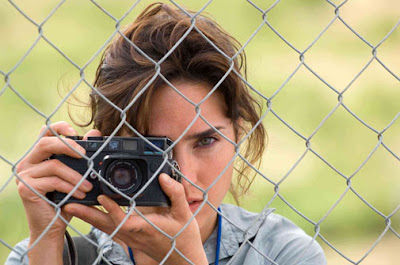
Jennifer, you need to CLOSE your other eye.
A seemingly unnecessary addition that clinches Blood Diamond’s caving in to
Hollywood formulae is Jennifer Connelly as the holier-than-thou Maddie, who’s been to Bosnia and Afghanistan and seems to be a journalist version Angelina Jolie. Maddie comes across as the maggot that crawls over the dead, who photographs their grief and puts it into words that creak under the weight of superlatives. She sits among the African refugees and watches over them, with that mixture of delightful curiosity and benevolence typical of scribes who do little more than make soap operas out of conflicts. If her performance was meant to annoy us, and make us gnash our teeth the way we do when we see such people on TV, Connelly succeeds admirably. Frankly, however, Maddie does not contribute much to the film – her exclusion wouldn’t have affected the film much – and besides, in the end, she too becomes the Hollywood heroine, sexy, teary-eyed and vulnerable, a pallid effigy in comparison to that of the drug addict in Requiem For a Dream.


But to the film’s credit, Archer and Maddie do not develop a romantic relationship, which would have stretched the film unnecessarily.


The African rebels are portrayed as a bunch of trigger-happy, drug-toting thugs who engage in rowdy and murderous deeds. Fair enough. Unfortunately, in my opinion, there is little of Africa about them, despite their tropical hideouts, clothes and accents. Perhaps it’s the accents, which sound closer to American Ebonics than authentic African. That plus the fact that they listen to violent “gangsta” rap makes them appear all the more Hollywood Ghetto – black kids from crime-infested suburbs – photoshopped into the jungles of West Africa.


There are some groan-inducing moments – when Maddie sits among the refugees in a gesture of contemptuous benevolence; when Archer, hit by a bullet, makes his last call to Maddie; and when the diamond merchants stand up and applaud a smiling Solomon Vandy. These scenes in particular are supposed to be moving, but they fail miserably.


One for you, and one for you, and...

At first glance, Blood Diamond appears to belong to that category of films for whom Cannes would be happy hunting ground. It’s all there – an unusual story of the violence surrounding African diamond exports; beautiful but scarred Sierra Leone, a country on the West African coast that is rarely portrayed in cinema; snapshots of village life, goats and fishermen; diamond thieves attempting to smuggle stones into Liberia using ingenious methods; African rebels recruiting child soldiers and training them with AK-47 assault rifles. The attempt certainly seems sincere, but the failure becomes apparent as the film progresses. It ultimately culminates in a clichéd all’s-well-that-ends-well where one protagonist dies in a blaze of glory and other starts a new life.

Blood Diamond certainly is a good film for the most part, both conceptually and visually – the green hills of Sierra Leone’s diamond country, the villagers fishing against the sunset, the locals hunting for diamonds at gunpoint and being shot mercilessly for disobedience; the rebels shooting every living thing in sight while kidnapping children for recruitment into their armies; and the mindless bloodshed and mayhem that ensues from the consequent conflicts. There is attention given to tiny details of African life - the places and ways in which smugglers hide the diamonds; Solomon’s anger at his wife on discovering his son is missing; the methods using which child soldiers are inducted into the rebel forces; and the streets and sounds of Sierra Leone. But, for a film into which so much effort has been put, with an unusual and authentic storyline, setting and depiction of the politics of world trade, Blood Diamond should have been more than just a film worth watching once.

Love Across The Ice Desert


A Review of MARCH OF THE PENGUINS (2005)
Original Title: La Marche De L'Empereur (French)
Director: Luc Jacquet
documentary


Think ‘penguin’ and the first thing that comes to mind is a flightless bird with flippers instead of wings, which looks rather like a plump little man in a tuxedo, and waddles clumsily across an icy plain. Right?

In that case, March Of The Penguins is an eye-opener for those who think they know all there is to know about these endearing flightless birds. It is also a wonderful film for animal and bird lovers and if it doesn’t lead one to respect these creatures, nothing else can.


Luc Jacquet’s documentary film on the life of Emperor penguins in the Antarctic is a visual treat in more ways than one. While wildlife documentaries always have the potential to fascinate, given the riot of colour, flora and fauna that the viewers would be in for, March Of The Penguins pulls it off like no other. For one thing, the odds are stacked against the film right from the beginning: the location is the coldest, driest continent on earth, Antarctica, where in the harshest weather, the temperature dips to a deadly –89 degrees Celsius (-121 degrees Farenheit.) The maximum temperature is 0 degrees Celsius! It’s a daunting challenge for any filmmaker to set up cameras in a place so unforgiving AND manage to create a beautiful film. But these people did it, and March is a glorious testimony to both the merciless beauty of Antarctica and to the unflagging human spirit - and, of course, to the world’s largest species of penguins and their amazing saga of courage and survival.


At the very beginning, we are treated to a series of frames that show nothing but ice floes that seem to stretch endlessly across the Antarctic. The only colours on screen are white and blue, and gradually we get to see speckles of black – the male Emperor penguins, their bellies filled with months’ worth of food, making their way to the breeding grounds that are an astounding 70 miles away.

To see the penguins painstakingly walking such a long distance on their clumsy feet in an orderly line, something beyond human capabilities, is humbling, especially considering that with all the technology at our disposal, many humans have died trying to conquer the South Pole. It is with awe that we watch them actually make it all the way, carefully and clumsily, to greet their compatriots with what seem like hearty honks of companionship. The camera does not mince details of the snowstorms and blizzards that are part of an Emperor penguin’s daily life, especially in the scenes where a few penguins that are slower than the others, have to make their way alone across the ice. It’s eerily reminiscent of lonely old men plodding down a deserted road, his feet ready to give way any time.


The courtship of the penguins is, in which they find their mates through singing in true cinematic style, is both comical and sweet. Since males are fewer than females, the law of Nature is sometimes reversed when the usually aggressive males are fought over by a few females. The males don’t seem to mind, and the narrator even makes a mention of how similar they are to human males. It is set to romantic music, which is beautiful but might seem cheesy; fortunately, however, the visuals are so arresting that the music does not overpower them. Several frames linger on penguin couples huddling together, resting after their long journey, or simply enjoying each other’s company. They are almost like humans in a bittersweet love affair, knowing they have to part soon, and the yellows and oranges on their bodies and beaks seem to be the only splashes of colour in the vast icy realm.


After three months of starvation, the female penguins lay their eggs, entrust their care to the fathers, and then head back to sea to break their fast, leaving the fathers to guard the eggs for a few months more. This is the time for the harshest weather ever to hit the continent, which literally epitomises the phrase “Hell Freezes Over.” It is incredible to see these penguins huddled in a circle, barely four feet high, holding their own against the harshest storms, taking turns to huddle in the centre so that each gets a term to be warm. All their aggression during the mating disappears and they work as a team to keep themselves and their eggs warm.

The appearance of the newborn penguin chicks - which look absolutely adorable and sing like nightingales - is almost like heralding spring. But no - they are born right in the midst of the icy storms. With their fathers starving and their mothers at sea, it is a miracle that most actually manage to stay alive. The fathers, though, manage to keep their chicks alive for the time being by feeding them special body secretions through their beaks; it’s a marvel their little bodies manage to manufacture anything in these times of starvation. Nature, the entrepreneur non-pareil, is at her best yet again.


The return of the mothers (with bellies full!) is met with much relief by the fathers - or so we’d like to think! It was amusing the way they looked up as if to say “Just WHERE have you been all this while?” After a brief period of togetherness, once the chicks have recognized their mothers, the fathers return to sea to eat after almost four months. Thereafter, the parents take turns going to and from the sea to take turns feeding their chicks. Finally, for the last time, the mothers leave them to fend for themselves once they are old enough. It was heartbreaking to see a few chicks, unable to accept this new turn in their lives, trying to catch up with their mothers! However, they eventually resign themselves to their fate, and continue to grow bigger. Eventually, they take to the water as if they were born in it, and it is amazing to see these rotund birds who look like walking eggs on land, travelling in the water like the sleekest of torpedoes. And the cycle of life continues to repeat itself.


Since penguins do not have access to technology like we do, they are completely at the mercy of Nature. The law of survival of the fittest cannot find a better place to be respected than on Antarctica. So it is only natural that these birds suffer several losses – the loss of eggs that have been exposed to the cold too soon after being laid; the winter causing more ice to develop on the seashore, forcing the returning mothers to travel longer distances and increasing their possibility of death; and the loss of mothers at sea, when they are eaten up by predators. More eggs are lost during the winter storms, which also claim some of the fathers; as are the newborn chicks whose father’s warmth could not save them; and finally, the chicks who are forced to die because their mothers have not returned in time and their fathers are forced to abandon them to feed themselves. It is a grim reminder of the fickleness of life, especially in Antarctica, but also of how tough these creatures are to survive in such conditions and still not be classified as endangered.


The mating habits of the penguins and their (temporarily) monogamous lifestyle makes it very tempting to compare them to humans. It is but natural that their way of dealing with their losses, not to mention the fact that they are flightless and clumsy on land and therefore, technically helpless, would affect us as a thinking and emotional species, but it would be wise to remember that they have been doing this for thousands of years. They may have smaller brains but are far ahead of us in terms of evolution, so it would not be prudent to take their society as something to model our own upon. Unfortunately, people have made their own socio-political interpretations of the film. Some consider the film as ideal propaganda material for the cause of “conservative family values”, with the father, mother and child being together, since this has been portrayed in the film along with several other behavioural patterns of penguins that are similar to those of humans. The filmmaker, Luc Jacquet, has expressed his outrage against these anthropomorphic comparisons and connotations, as have others.


Personally, I found it romantic and cute (the birds themselves are adorable), but not necessarily something that we humans need to model our lives upon. Frankly, if I were living in a place where the average temperature is –30 degrees Celsius, I’d be more worried about feeding myself rather than bringing up a family! It’s this mentality of people to compare humans and animals and try to bridge the gap that eventually creates ecological troubles. It would be wise to remember that all animals are millennia ahead of us, and we’re still infants as far as evolutionary history is concerned, and that the so-called “gap” is actually the size of Gondwanaland. It would be better to admire and respect them and look for ways to conserve them without disrupting the ecosystem, rather than to conjure up religious and social ideals in connection to them.


This is one of more than just an unforgettable documentary films, not only for its content but also for showcasing, in lush imagery, a place where there is practically nothing. The vast expanse of ice and snow is breathtaking and the sunsets and sunrises are spectacular, more so when the ice reflects the light and scatters it into myriad shades of pink, yellow and orange. One particularly outstanding scene is one where the egg-incubating male penguins are huddled into groups and the Southern lights - aurora australis - dance above, making it appear like a penguin discotheque. (This film was also thought to be the basis for the hugely successful Happy Feet, an animated film about an outcast Emperor penguin who becomes the hero of his tribe.) The courage it must have taken for the cameramen and everyone else involved on-location, to make the film while braving the snow and blizzards, is indeed admirable.


A treat for nature lovers and film buffs alike, March Of The Penguins is a must-watch and undoubtedly deserved its Oscar win for Best Documentary.


Viva La Jazz

A Review of Buena Vista Social Club (1999)
Director: Wim Wenders

documentary


Most documentaries are boring. It’s a fact that somehow a real life incident or person doesn’t seem as interesting when shown as-is, rather than in widescreen format with Dolby Surround, a glamorous ensemble cast, elaborate realistic sets and lots of extra spice. However, there are always exceptions to the rule – gems like William Nessen's The Black Road (I actually had the fortune to meet him when he visited NID), Elle Flander's Zero Degrees Of Separation, Mahnaz Afzali's The Ladies’, and that greatest of all documentary musicals, Buena Vista Social Club.


Olé!


The film traces the journey of American guitarist Ry Cooder and his percussionist son Joachim to Cuba in March 1998, in search of the forgotten musicians whose rhythms filled Havana nights in the years preceding World War II. These musicians were members of the Buena Vista Social Club, and used to perform regularly, with the club at its peak during the 1940s. The Cooders find these musicians living practically on the streets of Havana, almost forgotten, but very much alive as far as their spirit and extraordinary musical talent is concerned. Through the help of local musician Juan de Marcos González (who plays the guiro), who helps to regroup the members and coordinate their performances at the EGREM studios in Havana, the music from the old days is recreated. Needless to say, so is the magic.

The members include the honey-voiced son and bolero singer Ibrahim Ferrer (who also plays the conga, claves and bombo), singer Omara Portuondo (the only female member, who has worked with Nat King Cole), Compay Segundo (vocals and tres), legendary pianist Rubén González, bassist Orlando "Cachaito" López, trumpet player Manuel "Guajiro" Mirabal, percussionist Amadito Valdés and the younger members, laúd player Barbarito Torres, singers Manuel "Puntillita" Licea and Pío Leyva, and guitarist-singer Eliades Ochoa.

The film intersperses some of the band’s finest songs with interviews of the members speaking about their lives, along with footage of their live performances at Amsterdam in April and New York’s Carnegie Hall in July of that same year. It’s incredible hear Ferrer and Segundo sounding as robust as people half their age, and if there ever is such a thing as musical lightning, it’s ably demonstrated by nanogenarian González’s fingers flying over the piano keys, or by Torres playing the laúd behind his own back.. Tracks like Chan Chan” (the overwhelming favourite), “Dos Gardenias”, “El Cuarto De Tula” are just a few of the gems on the soundtrack. By turns bittersweet, sensuous and mischievous, it is as much an aural feast as it is visually.

I went to see Buena Vista Social Club because I expected to hear some mind-blowing Cuban jazz. Not only was I not disappointed, I left the theatre with the goosebumps still on my arms, long after the notes had faded into the recesses of my memory.

Integrity: Here Today, Gone Tomorrow

A Review of KAL (2005)
Director: Ruchi Narain
fiction

One look at the posters, and it is very easy to dismiss Ruchi Narain's directorial debut Kal as one of the endless cheesy youth-oriented potboilers being churned out by the Hindi film industry. Even worse, it’s easy to mistake it for Sudhir Mishra’s Hazaaron Kwaishein Aisi, on which Narain was an assistant, especially because it also features Chitrangda Singh and Shiny Ahuja, who play two of the protagonists in Kal.

But, as the proverb says, never judge a book by its cover. The very beginning of Kal is unorthodox, to say the least: Bhavana (Chitrangda), the protagonist, is tearfully viewing a bunch of video-messages on her Mac laptop, in chronological order over the duration of a year. Through these, and the voice of the narrator Rohan, we come to know the sketchy details: Bhavana and Tarun (Shiny) were very much in love and planning to marry, and had a great time with their gang of friends Sangeeta, Teji, and Bhavana’s best friend Maya. Unfortunately, Tarun falls in love with Maya instead, and marries her – a decision which causes a rift in the group. Everyone drifts apart – Tarun, whose marriage to Maya was against her family wishes, finally gains acceptance with her business-magnate father and quickly moves up the corporate ladder. Teji also goes to work for Tarun, which Bhavana sees as disloyalty on his part and apathy towards her heartbreak. Sangeeta goes to the UK to study law, and Bhavana pursues her career as a photographer. A tearful video-apology from Maya does nothing to soothe her ruffled feathers, and consolations from Sangeeta don’t work either. Finally, Sangeeta announces that she is coming down from the UK to celebrate her wedding in Mumbai, and asks Bhavana to come down for her wedding.

At the wedding, Bhavana meets Rohan, a journalist and a friend of the groom Shekar. Rohan, who is struggling to recover from a failed relationship, feels instantly attracted to her. Bhavana is still smarting about her breakup with Tarun but is surprised when Sangeetha reveals she didn’t invite either him or Maya, and even more surprised to hear they’re getting a divorce. Sangeeta tries her level best to hook Bhavana and Rohan together, and succeeds. Bhavana slowly gets into the party mood and later is very excited to be dropped home by Rohan. Just as she gets intimate with Rohan, Bhavana is shocked to find a very drunk Tarun in her house.

An embarrassed Rohan leaves in a huff, and Bhavana grudgingly lets Tarun stay the night, as he is too drunk to move. The next day, she leaves him still sleeping to go to work, and there she sees the news that Maya has died the previous evening. Horrified, Bhavana calls home only to find out that Tarun is missing.

From here the film accelerates to a mind-dizzying pace as allegations fly fast and furious between Maya’s family, the Jalans, and Tarun’s family, the Haksars, including Tarun’s socialite sister Ira (Sarika), and aided by the multitude pf presspersons hounding the prosperous families. Rajesh, Maya’s slimy brother, tries his level best to make sure her father, a heart patient, does not know of his daughter’s death, which had occurred the same night Tarun had been at Bhavana’s house. Bhavana, in a state of panic and still angry over her failed affair with Tarun, tells the police that Tarun was at her place that night, which instantly makes Tarun a prime suspect. Bhavana’s father Dayal (Boman Irani), who also works for Jalan, promptly returns from a holiday in Cochin on hearing the news. Tarun surrenders, get beaten up in jail, and slips into a short coma. Maya’s adoring younger brother Anuj comes down from the US, and the press goes berserk. There is now a rift between the Jalans, the Haksars, and Dayals – three prosperous families that were once friends. And in the midst of it all is the journalist Rohan, who is madly in love with Bhavana and yet trying to piece the puzzle together.

The film cuts speedily back and forth between the lives of Bhavana and Sangeeta, Maya’s closest friends, Anuj, Tarun and the drug-addled Teji (who, as it later turns out, was madly in love with Maya.) On the evening of Maya’s birthday, after Anuj throws a posthumous birthday party to honour her, Bhavana finds out that Tarun had not gone beyond the cigarette shop outside her flat; he had been too drunk to do so, and therefore definitely could not have killed Maya. Worse things happen: Teji goes insane, worrying Bhavana and Sangeeta further, while Tarun is still in a coma. Finally, Teji blurts out a shocking revelation: Tarun and Maya had procured a spy-cam developed by him to capture her brother Rajesh in the act of taking bribes. However, Rajesh found out, and Tarun turned against Maya for fear of his career. Thus Maya, who had helped her husband expose her own family, had suddenly found herself alone in a world of corruption she couldn’t live in, and was last heard threatening to kill herself.

Shortly after this, Teji is found dead of a drug overdose, apparently unable to handle any more. To make things worse, the Jalans set up an IT raid at the Dayals’ home and ask them to evacuate, the press is constantly hounding Bhavana and her family, Dayal resigns from Jalan’s company only to steal a file from his office, and Ira cannot seem to make up her mind on which side to take. In the midst of all this, Sangeeta calls Bhavana in tears and tells her that some of her belongings that had remained behind in London have just arrived. Among them is a tape made by Maya.

In the tape, Maya reveals that she was unable to take any more after Tarun had abandoned their moralistic pursuit of exposing her brother sided with him instead. As Bhavana and Sangeeta watch in shock and grief, she declares that she will kill herself. And the mystery is finally solved, but not without leaving Bhavana, Sangeetha and Anuj disgusted at the level of corruption right under their very noses. As a final act of revenge, Bhavana talks to the now-recovered Tarun using a spy-cam, and gets him to spill the beans on the actual events leading to Maya’s suicide, and the corruption that preceded it. She gives it to Rohan and helps Rohan prepare his TV expose on the Jalans. Thus, she repays Maya for saving her from a marriage to Tarun.

To her credit, the director has also taken into consideration the fact that all the characters are not black-and-white; there are shades of grey in just about everyone, and it is not easy to label them as good and evil. Also she makes a point that while we may think someone is doing something wrong, they are convinced that they are doing it right – which is the very foundation of the differences in ideology.

The film has its comic moments, which are but few. One is the scene where Anuj, Sangeeta and Bhavana go to a psychic to help them contact Maya in the netherworld – a hilarious reminder of the human tendency to take refuge in superstitions in times of desperation. And Narain is careful not to fall prey to aggravating clichés: song-and-dance sequences in Switzerland (given that the protagonists are so wealthy), and a comatose Tarun suddenly waking up and unable to remember who he is and how he got there. But it does have its groan-inducing moments, notably during the scene when a man stares at a TV in a shop window while it is airing the expose, and wipes a tear from his eye.

The cast is pretty well suited for the film, though Chitrangda seems too beautiful to be convincing as the girl-next-door that she was meant to be. Boman Irani, as usual, is the life of the film. Sarika is every inch the media-savvy socialite, and her return to the screen will be much looked forward to. Some of the costumes seem too glamourised and Bollywood-inspired but given the characters' high social status, it doesn’t seem very out of place.

For a debutante director, Ruchi Narain has done a brilliant job. Although quite long at two and a half hours, the narrative cuts so quickly between events and characters that before you can even digest a new twist, another one slaps right across your face. It does get a bit tiresome, but the confusion is genuine in the sense that it parallels the infinitely murky events in the story itself, which finally culminates in the explosive revelation that, sometimes, the only way to do something is to do it wrong.

Bad Education? Not From This Little Teacher

NOT ONE LESS (1999)
Director: Zhang Yimou
fiction

Chinese director Zhang Yimou my be better known for weaving opulent tapestry onscreen, beginning with Red Sorghum (1987) and climaxing with Raise The Red Lantern (1991). His most recent film following the same style was The House Of Flying Daggers (2004).

However, Not One Less, set in post-Communist China, is completely different. Its documentary-inspired style is reminiscent of Iranian films with its extensive coverage of the dusty Chinese village landscape. And as far as the story is concerned, its bitter-sweetness interspersed with moments of poignancy and innocent comic interludes is like revisiting Children Of Heaven.


Mei is a thirteen-year-old girl who has just finished primary school, and is not very good at her subjects. She is asked to fill in as a substitute for the village teacher Gao, who has to take a month off to go see his ailing mother. Mei, like most pre-adolescents, is least bothered about the job, but is quick to take it on for the fifty Yuan that she is promised. In fact, when one of the students, a fine runner, is selected to attend an Athletes School, Mei refuses to let her go, fearing4 that her salary may be cut if the number of students reduces.

Mei and her students don’t get along with each other at first – for them, she’s too young and is not as intimidating as Gao. And to her, they’re just a bunch of pesky kids on whom she shouldn’t be wasting her time, but the thought of the money spurs her on. She shows no interest other than writing a lesson on the blackboard for them to copy, and they grow increasingly cranky as she refuses to let them leave until late afternoon. Gradually, however, she earns the grudging acceptance of the class and learns to accept them too, and slowly begins to involve them in lessons and songs. Obviously, the classroom scenes make for the bulk of the comic parts of the film, with the children at their most natural and boisterous best.

One of the students is the exceedingly naughty Zhang Huike, who’s some sort of nemesis for Mei. He’s also the class bully and getting constantly reprimanded by her for his escapades. However, one morning Zhang is nowhere to be seen. Mei comes to know from the mayor that he has gone to the city to work to help his ailing widowed mother pay off some debts. Not wanting to lose another student, Mei enlists her class to help raise money for her trip to the city to seek out their classmate. They pool in their allowances and even move bricks to raise the cash, while the apathetic mayor refuses even to pay Mei her fifty Yuan in advance.

Two days after Zhang’s disappearance, Mei makes her way to the city despite the mayor’s protests, and this is where she realises that there are things beyond her realm of knowledge. As she desperately seeks out Zhang amidst the chaos, dust and noise of the city, Zhang is begging for food, unaware that he is being missed. Mei is forced to part with her money: a little to Zhang’s co-worker who accompanies her to the station to look for him, and the remaining to buy paper and ink to write ‘missing’ notices which she finally realises are useless as Zhang has been missing for three days.

Now completely penniless, Zhang clings to one last hope – a TV station where she was told she could broadcast a message. Naturally, she is not allowed in, and spends almost two days waiting until the sympathetic station manager decides to let her appear on a program that focuses on issues affecting modern China. Mei is introduced as a village teacher, and the dam finally breaks as she tearfully asks Zhang to return. As the episode is aired, Zhang, who has managed to find work washing dishes in an eatery, sees his teacher on his employer’s TV and breaks down.

All ends well with a happy student-teacher reunion and loads of donations from the kind city residents who see the TV show. As they make their way to the village, which gives them a hero’s welcome, Zhang vows to finish school and find a job so he can buy his young teacher some flowers. The remaining students cluster around Mei back in school as each takes out a bit of coloured chalk and lets new hope take shape on the blackboard in the form of various words: sky, water, diligence. Mei becomes the village heroine for her heroic stubbornness and single-minded devotion to her student.

The film is deeply moving with a heart-warming storyline, and should definitely rank among Yimou’s greats. The rural Chinese landscape is shown in all its rugged beauty and is well contrasted with the chaotic city crowds, concrete and traffic. The premise of the city-dwellers coming to the rescue of the villagers (yet again) seems like a kind of clichéd political statement, but that is only if you delve deep into it. Otherwise everything else is top-notch.

Not One Less is a wonderful tribute to the triumph of the human spirit against all odds. It is also a tribute to the oldest human relationship – that unbreakable bond between teacher and student.

One of the most powerful moments in the film is when village boy Zhang is asked by the TV host about his most lasting impression of the city. In all innocence, he says: “I had to beg for food. I’ll never forget that.”

All Smoke And No Fire?

The other day I was watching a popular debate programme on a news channel. The panel comprised a well-known filmmaker, a health ministry member and someone else who I can't recollect. After much fanfare, the host began : Is the ban on smoking in films justified?

I swtiched off the TV because I had my answer already: No!

Let me explain. The issue here is the visual of someone smoking. The problem isn't the cigarettes, it's the visual. Never mind if the man (or woman) onscreen is smoking an empty roll of paper - what the audience sees is someone smoking, which, according to the health ministry, could be a harmful influence on the viewer. The person who came up with the idea of this ban seems to have conveniently forgotten that cinema came to India in 1895, when the Lumiere brothers' first film was screened in Bombay. This was way after the arrival of the British, who made smoking a commonplace appearance and perhaps a status symbol. It wouldn't be too far-fetched to say that some of our countrymen were smoking long before the British arrived. India was primarily an agricultural country and one of the largest producers of tobacco in the world long before any smoking was shown in films a la Ramgopal Varma's Company. Does the accusation imply that people in India began smoking only after the movies came in?

How can the rise in health issues related to smoking be attributed totally to films? The Indian Tobacco Company was established long ago and even in the 70s, Gold Flake was a household name even among non-smokers. This was due to the invasion of the press. With magazines flourishing, ITC found a big place to showcase its cigarette brands. Even after the ban on print advertisements in the present day, ITC makes its presence felt through apparel brands and stationery. So why blame films and actors alone?

The Health Minister has expressed concerns that showing actors smoking onscreen can be a harmful influence on youngsters who idolise them. This may be true, but the fact remains that cinema is, like any other art, about illusion. What is shown on screen is not real. The actors portray fictitious characters, who resemble or respresent someone we know. They do not, and cannot, become the people they play, for obvious reasons - too much emotional and mental involvement in an art form that so closely imitates life is dangerous. People who die onscreen are not really dead, are they? In the same way, those who smoke onscreen are simply portraying fictitious characters. How do we know they are actually smoking? There are young conscientious actors who employ alternate methods - like Kirsten Dunst, who says that she smokes fake cigarettes which do not contain any tobacco, and Natalie Portman, who tried it once and found it "disgusting". Indian actor Aamir Khan opines that cigarettes should be allowed in films provided they do not glorify the character. (click here for Khan's statement in the Indian Express.)

It is for the viewers to understand that all that is being shown in a film is strictly representational and need not be real. If the viewers are smart enough to understand that actors who portray dead people aren't really dead, they simply have to apply the same principle to smoking. Unfortunately, most young viewers do not understand that even the hero can have shades of grey, that smoking can be one of his vices. If cigarettes are a bad influence, we can say the same about fraud, theft, rape, adultery and violence. They can also be harmful influences on viewers - so do we ban their depiction completely? In that case, we can also argue that portrayal of poverty, socio-economic crimes, death, etc. should be banned because viewers would be emotionally traumatised. Next, we'll be banning films altogether, and that can have serious consequences in an economy that produces the largest number of films per annum.

It is impossible not to show people smoking, atleast in some films. In Hollywood, the fake cigarettes are used, which do not contain tobacco and give out only smoke. This is a healthier way to show a character who smokes, without having to eliminate the existence of such a character altogether and limit the film's possibilities. The only way to prevent depiction of smoking in films is to ban it altogether by criminalising it - which is easier said than done in a country which is the world's second largest producer of tobacco.

This brings to mind another problem - the absence of a rating system instead of an overzealous censor board. A decent rating system could be used to categorise films as 'R' if they have nudity, drug use, extremely foul language or potentially offensive content (including possible racism/ communalism/ political propaganda etc.) Smoking could also be included in this category. This will ensure selective viewing without having to compromise on creativity. (Click here for relevant article on 'R' rating smoking in Hollywood.)

Just think ... cigarettes have revolutionised cinema in more ways than one. Smoking has been an integral part of film for decades - there are characters in our stories that would never have been the same without their tobacco addiction. Conjure up in your mind images of the arrogant lord puffing on a hookah while the courtesan flits her eyelashes at him ... a hippie Zeenat Aman with flowers in her hair and a cigarette in her hand. Can you imagine Amitabh Bachchan as the angry young man without his cigarettes? Amjad "Gabbar Singh" Khan shouting tera kya hoga kaaliya without a cigarette dangling from his mouth? Randeep Hooda glaring into the camera minus the smoke swirling from his nostrils? Juhi Chawla and Sanjay Suri sharing a forbidden smoke years before his homosexuality, and eventually his HIV affliction, is discovered?

And if cigarettes didn't exist, what would Rajnikanth stylishly toss into the air and catch in his mouth? Salad?

... And Life Whimpers For Breath In This Barren Land


A Review of BLACKBOARDS (2000)
Director: Samira Makhmalbaf
fiction

He climbs the rocky slopes, clutching a black plank of wood across his back. He is starving and tired, but has a burning desire to quench the thirst for knowledge of anyone who needs it, and all he wants in return is a scrap of bread and some water.


Sayid is a teacher, with no belongings except his treasured blackboard and some chalk. He and his colleague Reeboir, just two of an entire group of teachers, have only one desire in life: to teach math and Arabic to anyone who is willing to learn. They scale the barren cliffs on the border between Iran and Iraq, in constant danger from war-bombs, carrying their blackboards like Christ's crosses (Click here for relevant article.) As they keep one eye on the narrow slopes, the other on trigger-happy soldiers, and separate from the group and each other, the future looks bleak. None of the people in any of the villages in the valley seem to want an education, as they're too busy being frightened for their lives.

Samira Makhmalbaf made Blackboards when she was just 20, no mean feat despite being the daughter of acclaimed Iranian director Mohsen Makhmalbaf. The film, her second feature after the controversial Apple (click here for related article) which she made when she was barely 18, is both poignant and disturbing.

Sayid meets a group of elderly Kurdish men searching for the road to Iraq, while Reeboir joins a group of young Kurdish boys smuggling goods over the border. The film is actually quite humourous in the beginning; it's a strange feeling to laugh when the characters onscreen are hungry and tired and have absolutely no idea that they're being funny.

The elderly men are struggling to get one of the members to urinate, and he is in agony. Sayid joins the group despite many protests, and persists in asking them if anybody is interested in learning to read and write. He becomes a nuisance, and nobody is willing to share their scanty reserves of food or water. Finally, a deal is struck when Sayid agrees to take them to the Iran-Iraq border for forty walnuts. Thus he becomes a strange part of this pious and elderly Kurdish group.

The old man, who is unable to urinate, is suffering and wants to get his daughter married off so he can die in peace. Thus one of his acquaintances decides to get the old man's daughter Haleleh married off to Sayid. The nuptials are hurriedly performed without ceremony, with Haleleh barely concentrating as she tends to her young son. Thereafter Sayid tries to teach Haleleh to read and write 'I love you', but she always ignores him.

In the meantime, Reeboir persists in trying to convince the group of boys about the advantages of an education, and all the while they're looking at him as if he's the idiot. However, One of them, also named Reeboir, shows a keen interest in learning, and a relieved Reeboir Sr. coaches him on spelling and pronunciation as they make their way along the perilous slopes. It is only when they stop to rest that the boys tell Reeboir that most of them do know how to read or write, but they're too busy trying to save their lives.

Sayid is finding hard to get Haleleh to talk to him, let alone say 'I love you'. Haleleh's father is still unable to urinate, while her son on the other hand, seems to be the opposite. Even a dip in the icy water of a nearby lake seems to do no good to the suffering elderly Kurd. Sayid meanwhile, tries his level best to fit into the group and woo his wife at the same time, trying to use the welcome pool of water as a catalyst.

Reeboir sets the fractured leg of a boy who falls off a cliff, but that still doesn't break any ice with the boys. They are all the more wary of getting close to him, except Reeboir Jr., who is still an eager learner. As Reeboir Sr stops to have some goat milk from a little girl - he tries to teach her too - his young namesake tries to spell his name. Unfortunately, just as Reeboir Jr. finishes the task successfully, he is hit by a bullet from the nearby border patrol. The rest of the group scatters wildly all over and many children are injured, some fatally. And no one knows what happens to Reeboir.

In another part of the border, Sayid manages to show the group of elderly Kurds the way to Iraq, but only after they refuse to believe him and almost get shot at in the process. Haleleh wants to go too, so Sayid is forced to divorce her and give her his blackboard as dowry. They walk off in opposite directions, and as the fog blinds them to each other forever, the words are still visible on the blackboard: I love you.

Samira has tried to show the rugged beauty of the barren, rocky border, and has openly showcased her sympathy for the displaced Kurds. Even the most heart-wrenching love is always touchingly funny, and the scenes featuring Sayid's attempts to woo his wife are just so. The poignancy reaches its climax in the last scene when Haleleh walks away with the blackboard bearing Sayid's words: I love you. It seems as if these words will continue to echo in the mountains long after Sayid's parting with Haleleh and his trusty blackboard, along with the echoes of Reeboir's voice teaching Reeboir Jr. to spell his name.

One scene especially, is searing: when there is more shooting on the group of elderly Kurds, Sayid gallantly hides Haleleh and her son underneath his blackboard. Haleleh's father finally manages to urinate, and this looks like a very strong moment of symbolism in the film, and we are just as relieved. For a while we are fooled into thinking that everything is over, that Haleleh will concede to Sayid, that her father is now all right, and that everything will be a happily-ever-after.

Unfortunately, we are reminded yet again that in the war-torn, mine-infested, barren beauty of the Iraq-Iran border - as on the borders of Israel-Palestine, India-Pakistan, Bosnia-Serbia - happy endings are rare.

Welcome To Dystopia

A Review of NO MAN'S LAND (2001)
Director: Danis Tanovic
fiction

Oscars 2002 was one of the memorable years for Hindi cinema, when Lagaan made it to the nominations for Best Foreign Film, standing its ground shakily among stalwarts like Amelie. While a lot of us know about Lagaan, what with the high PR and photo-ops (and even a book), it was a little-known contender from Bosnia-Herzegovina that came up trumps: Danis Tanovic's No Man's Land.


No Man's Land is the story of two enemy soldiers, Bosnian Ciki (Branko Djuric) and Serb Nino (Rene Bitorajac) who happen to discover each other in the same trench. Both men cannot move out as they could be attacked by both sides, so they trade insults while they wait for night to fall. To add to the tension, Ciki's friend Cera, who has been presumed dead, regains consciousness. However he cannot move as he is on a bouncing mine, which can explode destroying everything within a 50 mile radius. So Ciki and Nino are forced to team up to save their lives as well as Cera's.

What could have been a dark, depressing war movie a la Saving Private Ryan is surprisingly funny, especially the tension between Ciki and Nino. At the beginning, Ciki has a gun, so he constantly threatens and berates Nino, and Nino can't do a thing because he has no gun. Sample this gem:

Ciki: So, tell me. Who started this war?
[Nino is silent.]
Ciki: WHO STARTED THIS WAR?
Nino: [long pause] We did.

Then, when Ciki lets his guard down, Nino grabs a gun and points it at him.

Nino: [chuckles] Now, tell me. Who started this war?
Ciki: [long pause; looks down] We did.

Then, when both of them have guns:

Ciki: YOU started this war!
Nino: No, YOU did!
[the argument continues, annoying Cera, who starts to weep]
Cera: Will you both shut the f**k up?

Despite the funny exchanges, the despondency of war still looms ominously. You find yourself willing the men to continue talking, to do all they can to ease the depression, to help you forget that this is a war which has claimed several lives and, any moment, can claim lots more.

There is also humour in the Bosnian and Serb camps, as well as the UN's French headquarters, supplied by overweight soldiers and hungover commanding officers, and the High Commanding officer of the UN has a young female secretary whose face is not seen as frequently as her shapely legs beneath a tiny skirt. (This is where the film temporarily shows a danger of evolving into another Hollywood war flick.)

A courageous French sergeant who tries his level best to help the two stranded men, is confronted by a very annoying, brash English reporter who wants to be in the thick of the action and almost gets him court-martialled. Finally they are allowed to film the rescue operation from a distance.

The humour continues when the forces go to rescue Ciki and Nino. Ciki does not want to leave Cera behind, and will not allow Nino to leave either. Nino is furious, and attempts to stab Ciki with Ciki's own knife. Soon the UN forces are forced to call a German mine expert to help defuse the mine. However, all hopes of a happy ending are dashed when the Peacekeeping forces figure out that there is no way to rescue poor Cera.

A reluctant Ciki and Nino are hoisted up, but Ciki is still smarting from Nino's stab attempt. He grabs a gun and kills Nino, and the UN soldiers are forced to kill him out of self-defence. At the end of the encounter, everyone sadly moves away, leaving Cera to die. The movie ends on a long, disturbing take of Cera, still lying on the mine in helpless hope, pain and fear with a photo of his beloved in his hand.

You are left shaking your head at the pointlessness of war, of the sheer waste of time of the soldiers, peacekeeping forces and civilians whose lives are on the line. You feel for the men in the trenches who lie there for days at a time, not sure of ever seeing their loved ones again. For the innocent civilians who are caught in the crossfire. For all the people who pick up the broken pieces of their lives and try to move on. As you take in the bleak landscape, lush yet barren, you can hear in your head strains of Vedran Smailovic's exquisite cello weeping at the sheer stupidity of it all.

The message is clear: War Doesn't Work. Ever.

Truly Moving

A Review of GARDEN STATE (2004)
Director: Zach Braff
fiction


For a bad start, it was a Monday in the dorm. Mondays are bad enough, and when you're in a place that leaves you little time to watch movies at the theatre, it's worse. I was bored to death, and sick of the usual flicks - and dreaded watching another Hollywood film because I sure wasn't ready to spend the remains of my allowance on something that looked like a mix of Harry Potter, romantic comedy and whodunit. They all leave me somewhat numb.


Just as I thought movies had lost their capacity to 'move' the audiences emotionally, I chanced upon an obscure indie film directed by a little-known guy from New Jersey. And was proved wrong less than two hours later.


Garden State, the feature-length directorial debut from Zach Braff (currently known to Indian viewers as leading man "J.D." and sometime director of Scrubs [Thursday nights 8 pm, Star World]) is a truly heartwarming juxtaposition of arthouse and romantic comedy. All the characters are dysfunctional in some or the other way, especially the main characters Andrew Largeman (Braff) and Samantha (Natalie Portman in a stellar performance). The two share a sparkling chemistry - Sam as a compulsive liar who suffers from epilepsy is a perfect foil to the straight-faced LA TV star Andrew. The latter's mind is numbed by years of drugs prescribed by his psychiatrist father as a cure for his 'angry' youth which resulted in the accident and consequent paralysis of his mother, and he is intrigued by the chirpy yet achingly fragile Sam.


Trippy
The story is about Andrew's return for his mother's funeral, his meeting with old acquaintances, his discovery of how every single person is a bit of a cracked egg, and ultimately his confrontation with his father and coming to terms with his mother's death. Along the way he finds an unlikely soulmate in the lovely, childlike Sam, and his painful voyage of self-discovery ends on a happy note with doors opening to a new life.

Writer-director-actor Braff reportedly wrote this script while still in college studying film, and it shows in the combination of unusual imagery and the film being centred on people in the 18-30 age group. All the characters are in their mid-twenties, and all are suprisingly vulnerable. For all the talk about adolescence being a passing phase, the movie convinces us that this age that can be the most trying time. One not only has his/her career and personal life in mind, but also starts wondering what direction his/her life is taking. There is subtle maturity and philosophy in every frame.

awwww.
Technically, the film is quite sound for a debut. There are a few continuity problems, but aside from that the characters are startlingly believable and the story is heartwarming. Braff pays rich tribute to his native New Jersey in the outdoor shots, and the warm amber lighting in the scenes featuring Sam and Andrew lend a strange aura of purity to their intimacy. Portman and Braff won several accolades (including a well-deserved Best Kiss at the MTV Movie Awards) for convincingly etching the childlike, bittersweet romance that blossoms between Andrew and Sam. Braff also brought home a Grammy for the best compilation soundtrack heard in ages, featuring everything from an invocation to Lord Ganesha to Coldplay, Thievery Corporation, The Shins, and Bonnie Sommerville.


For those not following the Golden Globe nominations, Braff has received a nod for best actor in a Comedy/Musical for Scrubs. If Garden State was anything to go by, this was not altogether unexpected, and he is certainly one of the top writer-director-actors to watch out for.

Another character that stands out in the film is Andrew's buddy Mark (finely portrayed by yet another dark horse, Peter Sarsgaard.) Sarsgaard has had roles in Boys Dont Cry, The Man In The Iron Mask, K-19:The Widowmaker, and had made his debut in Dead Man Walking. Just look at the first and the last names among the films listed above - Garden State proves that this is one more character actor who looks set to make it big.


So rent the DVD, sit back and rest assured that humanity is very much alive and kicking. Some 'moving' images do live upto their name.

Not So Hot!

A Review of GARAM MASALA (2005)
Director: Priyadarsan
fiction

Our first semester jury had just ended and I was, ahem, acquitted. So to celebrate the triumph at the trial, a group of pals and I headed out to a fast-food joint to eat. On the spur of the moment we decided to see a movie, and we had three choices - Ek Khiladi Ek Haseena, Garam Masala, and some obscure Gujarathi film whose name I couldn't read. The obvious choice? You guessed it, though I admit we chose to see GM not because of the content but because of the male content ;)


The movie began, as all Bollywood movies do, with a bang. Good ol' Mauritius with gorgeous sets, gorgeous women and gorgeous photographers Mac (Akshay Kumar) and Sam (John Abraham) having a whale of a time ogling them. There's the done-to-death Adarsh Bharatiya Nari Rimii Sen as Anjali, Mac's fiancee (for God's sake! Do single Indian women working abroad wear salwar kameez all the time???) Fortunately she doesn't have too much screen time. Neha Dhupia appears for a few minutes, which is a pity because she seems to have put in a decent performance in whatever little screen time she had.

Mac is a photographer with Garam Masala magazine and Sam is his assistant, and both have the hots for Maggie (Dhupia), the receptionist at their office. Mac's the boss but when Sam wins a photography competition by fluke, he gets a raise, a trip to the US and Maggie. Mac wows to make Sam sorry and jealous and proceeds to con three exceedingly pretty airhostesses Deepti, Pooja and Sweetie. With the help of the poker-faced housekeeper Mambo (Paresh Rawal) and a car mechanic called Babban, Mac manages to narrowly keep the three girls from discovering each other. As it gets increasingly difficult with frequent changes in flight timings (even the flights abroad seem to be irregular!) Mac is at his wits' end. Reenter Sam, who has returned from the US, and all hell breaks loose as the men try to keep the girls and cover up for Mac at the same time. Finally, after an needlessly long time, the cat's out of the bag and Mac is forced to flee with Sam in tow.

The movie is overall genuinely funny, though it drags a bit towards the end. It's a treat to see macho Kumar and metrosexy Abraham deviate from their usual sophisticated last-man-standing portrayals and play a couple of goodlooking but royally goofy guys who seem to be falling most of the time. Kumar has established himself of late as a fine comic, and Abraham shows promise of getting there. But Paresh Rawal as the droll housekeeper Mambo is simply brilliant. His sense of comic timing is perfect and his grumpy face shows a lot of expression without too much movement. It's a pity the movie didn't turn out better.

The flaws are the usual suspects - too many pretty women (it's often difficult to differentiate between the three airhostesses, both from each other and the side dancers that accompany them), too many songs, and too many uneccessary details. For instance, it would have been wonderful to show a few bits of Mac and Sam's bonding at their old apartment, rather than for just one scene, because male bonding almost always works in films (Remember Shah Rukh Khan and Saif Ali Khan in Kal Ho Na Ho?) Kumar and Abraham show good chemistry, and are good together with Rawal. Personally though, what riled me is that Anjali forgives her fiance for cheating on her with three women at at time! Beats me what spineless fiancee would put up with that. And if the men are dumb, the women seem to be even dumber, and suspecting the mysterious appearance of food they didn't ask for and another woman's handbag doesn't make them look any smarter, because Mac manages to convince them at the end. This isn't Priyadarsan at his best but its shows a lot more promise than Kyon Ki.

Watch it for a good time of laughter with friends, and of course, if you have a crush on Kumar and Abraham. This masala goes well with some chai.