Showing posts with label fiction. Show all posts

All That Glitters Is The Barrel Of A Gun

A Review of BLOOD DIAMOND (2006)
Director: Edward Zwick
fiction


Sierra Leone, Africa, 1999. The famous diamond mines in this beautiful African nation are the reason for a terrible bloodbath raging across the country. Native Sierra Leonians are massacred by members of the RUF (Rebels United Front) who want to recruit people into their war against the government. They force the natives to hunt for diamonds that they want to smuggle into Liberia and export as Liberian diamonds. Those who try to pocket the precious stones are shot dead by the RUF, and those who manage to make it to the border are intercepted by the government officials. Since those stones are exported at great risk, they are sold for astronomical prices to Dutch and Belgian diamond merchants in England.


The film chronicles one of those many stories, which entwines the lives of three characters. Solomon Vandy is a native fisherman with a wife and children, who leads a simple life. Danny Archer is a white South African mercenary who smuggles diamonds into Liberia and routinely gets arrested. Maddie Bowen is an American print journalist who is on assignment to chronicle the bloodbath in Sierra Leone.

looks like Leo's running on his face rather than his feet

While being forced to work in the fields, Vandy discovers a rare pink diamond, and hides it. However, the RUF leader spies him and tries to kill him, but they are intercepted by the government forces. Later, when they are both in prison, the RUF leader loudly accuses Vandy of having it on his person, which the latter vehemently denies. Archer, who is in prison for attempting to smuggle diamonds to England-based Dutch jeweller Van Der Kaap, hears this. He is intrigued and wants to get his hands on the diamond. Later, the RUF kidnaps Vandy’s son Dia, and Archer uses this as an opportunity to get the diamond in exchange for getting Dia back. To do this, however, he has to enlist the help of the inquisitive Maddie, who will not rest until she has the inside story of the coup and Archer’s part in it.


So between them, they strike a deal: Maddie helps Archer and Dia get to Sierra Leone safely through the rebel territory, while Solomon helps Archer get the diamond in exchange for rescuing Dia with Maddie’s help. However, while returning, they are set upon by the rebels again, and Archer is forced to make a final decision between his diamond and staying back in his beloved Africa. He chooses the latter, and Solomon, who manages to escape, agrees to trade in the diamond in exchange for asylum in England – which is dutifully caught on camera by Maddie. As a result, Van Der Kaap lands in trouble, and the end shows a conference in South Africa where Vandy is much applauded and diamond merchants from around the world resolve to stop the trade of blood diamonds.


I'm a serious actor. Yes, I am. No, really.
Sadly, Leonardo DiCaprio as David Archer could have been better etched. As a South African white and former member of a rebel army, now making a living as a diamond smuggler, there is a lot of potential for fleshing him out. But, despite his perfect Rhodesian accent and efforts, he is ultimately relegated to being the glamourous Hollywood hero – good-looking, suave, fetchingly single, and a gold-hearted thief to boot. A pity, considering that he is capable of fine acting, as evidenced by his recent performance in The Departed.


This sucks. I hope I don't look bored...
Djimon Hounsou of Amistad fame, who plays Vandy, seems pretty wasted in a role that doesn’t require him to speak much. His performance appears a little stiff, but for a simple villager, whose only goal is to get back his son Dia from the rebel army, it is evocative enough. Unfortunately, his character does not have as much screen place as Archer, and his expressions are limited to intimidating glares. Again, a potentially interesting character pushed into oblivion.
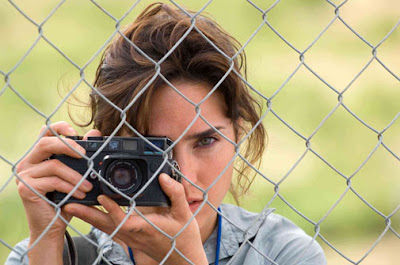

Jennifer, you need to CLOSE your other eye.
A seemingly unnecessary addition that clinches Blood Diamond’s caving in to
Hollywood formulae is Jennifer Connelly as the holier-than-thou Maddie, who’s been to Bosnia and Afghanistan and seems to be a journalist version Angelina Jolie. Maddie comes across as the maggot that crawls over the dead, who photographs their grief and puts it into words that creak under the weight of superlatives. She sits among the African refugees and watches over them, with that mixture of delightful curiosity and benevolence typical of scribes who do little more than make soap operas out of conflicts. If her performance was meant to annoy us, and make us gnash our teeth the way we do when we see such people on TV, Connelly succeeds admirably. Frankly, however, Maddie does not contribute much to the film – her exclusion wouldn’t have affected the film much – and besides, in the end, she too becomes the Hollywood heroine, sexy, teary-eyed and vulnerable, a pallid effigy in comparison to that of the drug addict in Requiem For a Dream.


But to the film’s credit, Archer and Maddie do not develop a romantic relationship, which would have stretched the film unnecessarily.


The African rebels are portrayed as a bunch of trigger-happy, drug-toting thugs who engage in rowdy and murderous deeds. Fair enough. Unfortunately, in my opinion, there is little of Africa about them, despite their tropical hideouts, clothes and accents. Perhaps it’s the accents, which sound closer to American Ebonics than authentic African. That plus the fact that they listen to violent “gangsta” rap makes them appear all the more Hollywood Ghetto – black kids from crime-infested suburbs – photoshopped into the jungles of West Africa.


There are some groan-inducing moments – when Maddie sits among the refugees in a gesture of contemptuous benevolence; when Archer, hit by a bullet, makes his last call to Maddie; and when the diamond merchants stand up and applaud a smiling Solomon Vandy. These scenes in particular are supposed to be moving, but they fail miserably.


One for you, and one for you, and...

At first glance, Blood Diamond appears to belong to that category of films for whom Cannes would be happy hunting ground. It’s all there – an unusual story of the violence surrounding African diamond exports; beautiful but scarred Sierra Leone, a country on the West African coast that is rarely portrayed in cinema; snapshots of village life, goats and fishermen; diamond thieves attempting to smuggle stones into Liberia using ingenious methods; African rebels recruiting child soldiers and training them with AK-47 assault rifles. The attempt certainly seems sincere, but the failure becomes apparent as the film progresses. It ultimately culminates in a clichéd all’s-well-that-ends-well where one protagonist dies in a blaze of glory and other starts a new life.

Blood Diamond certainly is a good film for the most part, both conceptually and visually – the green hills of Sierra Leone’s diamond country, the villagers fishing against the sunset, the locals hunting for diamonds at gunpoint and being shot mercilessly for disobedience; the rebels shooting every living thing in sight while kidnapping children for recruitment into their armies; and the mindless bloodshed and mayhem that ensues from the consequent conflicts. There is attention given to tiny details of African life - the places and ways in which smugglers hide the diamonds; Solomon’s anger at his wife on discovering his son is missing; the methods using which child soldiers are inducted into the rebel forces; and the streets and sounds of Sierra Leone. But, for a film into which so much effort has been put, with an unusual and authentic storyline, setting and depiction of the politics of world trade, Blood Diamond should have been more than just a film worth watching once.

The Junction

A Short Story


The rumble comes suddenly. First I hear it, then I feel it beneath my feet. The Earth's snores. I wouldn't blame her; the toxic fumes of industrialisation have probably worsened her sleep apnoea.

I look up at the sky – or whatever is visible of it from a sidewalk of the urban shopping area. Renovated Victorian buildings jostle for space alongside billboards and lamp-posts; the sky seems far away, left out of the hallowed circle. Monsoon clouds as out-of-season as last year’s platform shoes are slowly rolling in; a heavy breeze, like a gigantic invisible mouth, blows on the dying embers of red autumn leaves. Yet, the leaves do not blaze emerald with renewed strength; instead, they scatter with the gusts, eventually out of sight, leaving bare branches in their wake. Here and there pointillist patches of green cling valiantly as if in knowledge that their perseverance will be rewarded by showers.


I clutch my shopping bag safely to my chest. These are the new-fangled "environment-friendly" paper bags, they said, which pleased me. Nestled within was a treasure; a gorgeous coral satin negligee for my new sister-in-law, a black bomber jacket for my brother, earrings of pearl set in sterling silver for a cousin, and a snazzy pair of Nikes in time for a nephew’s inter-collegiate basketball tournament. I feel like Santa Claus, except I drive a sports car instead of reindeer and my toys are in a fancy paper bag instead of a sack. Unfortunately, it will be a while before someone makes environment-friendly bags that are strong enough to withstand Nature's windy tantrums.


I regret wearing my new shoes - faux leather camping boots that cost a bomb and look smashing, but I doubt if they'll be the same after wading through ankle-deep puddles of acid rain. I regret wearing my new maroon rain parka because a passing car will splash muddy water all over me and ruin the French velvet trim. I regret buying that new shade of lipstick I didn't really want because it’s a deep violet – too Goth for my taste. Why did I buy it? To impress someone. Who? Anyone. I don't know. And in all likelihood, probably never will.


The bill peeks out of the paper bag, ready to fly away and take with it all proof that I bought all this; with my own money, which I earned from my respectable job as a ad copywriter, which I secured through my own meritorious college education, which I got on a scholarship. All proof that I have even lived. I tuck it in deeper inside the paper bag, then on second thought, decide that it is a better idea to put it into my grey purse in full view of everybody. It would be stronger proof of the power I wield through my financial independence. Brandish thy ruby-studded sword in the enemy’s face, I say.

(What enemy?)


I stop at the traffic junction of the two lanes, one going north-west and the other going south-west, that meet the one-way road opposite; along that road, in the midst of banks and restaurants, is the car parking. That’s the trouble with space in the cities nowadays – they’re filled to the brim with too many buildings that have too many people, who have too many cars, mine included. The parking is a good hundred metres away from the mall, and every time I go shopping I have to wade through a blanket of traffic-generated dust and smoke – dust and smoke that defeats the purpose of bathing, let alone makeup. (Yes, that lipstick really bothers me.) But I can’t go return it; it wouldn’t be proper, because a few hundred rupees shouldn’t mean much to someone like me, right?


Opposite, near the car parking, I notice an elderly woman. I see her every time I visit the mall; she’s blind, and makes a living hawking roasted gram. Her husband, who’s also blind and elderly, sits a little distance away, wrapped in a tattered purple shawl patterned with fluorescent, almost iridescent yellow flowers. I haven’t seen him that often; he doesn’t seem particularly disabled, and I’ve often wondered why he doesn’t work like she does, though I seem to remember him sometimes directing the owners of the cars whenever they’re reversing out of the parking lot. He probably used to have extraordinary hearing in his youth, as do most blind people; but now he’d be a little deaf. One can’t possibly be aurally keen after years of staying all day in the vicinity of blaring traffic horns.

Probably lives off her earnings, I think. Just like other husbands. There’s no parasite like old parasite.


Together, the sight of their tiny ramshackle cart of pulses against row upon row of shiny sleek cars makes for that typical tradition/modernity composition, dutifully executed by all those kids in the arts college downtown, who end up putting the same kind of paintings at every exhibition; of street urchins watching city schoolboys playing cricket, of the teenage girl with a baby sibling on her hip selling balloons at traffic junctions. Of elderly hawkers selling roasted gram in front of a gargantuan shopping mall.


The light turns red, and I start to cross. Of course, just because the pedestrian sign is green doesn’t mean we have the right of way. A couple of bicycles zip past in violation, and one pockmarked fellow leers at me and shouts out something I don’t hear and don’t care to hear; but nevertheless, I pull my parka down over the back pockets of my jeans.


As I approach the old woman, I impulsively reach into my purse and pull out a five-rupee note, as I always do. I can never eat anything off a street while I’m dressed like this, but I can also never walk by her and not contribute to her daily bread while I’m dressed like this. But I’m protected from the stares of the public by the one-way traffic that hurtles past the parked cars, away from me. Also the sunglasses, which I like to think of as a cover for this - my occasional two-minute private rebellion against the trappings of my upper-class comfort. When I’ve been in this area at night-time, I’ve even driven all the way home with one hand on the steering wheel and the other popping gram into my mouth, with the local radio station playing Bollywood songs of yesteryear. No chance of being spotted; in the dark busy lanes of Mumbai, when every car is just another set of blinding headlights and honking horn, I’m invisible and safe from the embarrassment of being spotted slouching below my income.


I walk towards her, when there is a loud cracking sound. Suddenly the atmosphere is awash with grey wetness. The honks in the passing traffic behind me grow more pronounced and punctuate the atmosphere with increasing frequency; splattering sounds of running feet pick up tempo. In between, my ear catches a few shouts of delight.


I turn back to the old woman, intending to give her the note and slip away. I can’t buy the gram now; it’d be too soggy, obviously, but the rupee note can be tucked in somewhere in the folds of her sari and used when it’s dry, and I’d be done with my Benefaction For The Week. But she’s ignoring me; instead, she’s hurriedly covering all her precious gram with cheap plastic lids. Her husband is helping her out, which surprises me; I never thought that man does anything other than sit in a place all day and chatter with other vendors.

He puts a lid on the last black-iron vessel of gram, and just as I step forward, takes the tattered purple shawl off his shoulders and wraps it around his wife, so it’s covering both of them. His arm around her shoulder, they walk away quickly, pushing the cart, huddled together, the warmth of their bodies impervious to the rain.


Blurred figures run past, their movements and voices painting mixed emotions: squeals of delight. Two boys run with chickens tucked in their arms. A lone businessman in a long khaki raincoat, his head unprotected, hails taxis. All this when there was hardly any lightning! Two men carrying their shoes in their hands, united under a broken black umbrella, navigating the slush. Hurry, the electricity might get cut. A group of college girls on their way back from a soppy movie. Muffled sounds of togetherness.


And in the midst of it all is me, standing right outside my parked car in the downpour, drenched faux leather and velvet and paper bag of treasures, far poorer than anyone else in that junction.

A Phoenix In Dystopia

A Review of ORYX AND CRAKE (2003)
Author: Margaret Atwood
fiction


This has got to be one of my more indulgent weekends. For starters, there was The Little Prince, followed by the main course: Oryx And Crake.

Oryx And Crake is set in Margaret Atwood's Dystopia - a futuristic time and place on the very brink of destruction, to which mankind has brought itself through its own actions. The setting is remniscent of her other novel, The Blind Assassin, but the narrative is two-pronged and simple. The protagonist Jimmy is a romantic idealist, one of the few surviving "true" artists who feels out of place in his transgenics-addicted society he's been brought up in. A recluse with no friends other than the brooding yet misguided genius Crake, and the mysterious, fragile Oryx, the only woman he's ever loved.


The narrative oscillates between Jimmy the Snowman, who lives in the present with a group of mutated, chlorophyll-blooded humans created by Crake, and for some reason considers them his responsibility; and Jimmy the dreamer, the artist who tried to find the rain-kissed dirt road under the silicon-asphalt debris being contructed by his peers. The man who tried to cling to his past and the pasts of those he loved, while everyone else around him was fashioning new creatures and gizmos in an attempt to achieve the impossible, regardless of the consequences. It is gripping, yet at the same time leaves you with a sense of hopelessness. But Atwood manages to keep the reader's interest up, though she tends to ramble in places. The book doesn't end with a bang and neither with a whimper; rather, a whisper. She leaves it to the reader to interpret the ending as perhaps a beginning.

Interestingly, Atwood refuses to elaborate on her descriptions of the new-fangled creatures and terms in the book. The effect is eerie, in a way, as if she expects us to recognize this dystopia immediately, because that's where we're headed.

Jimmy is the son of scientist parents and the product of a dysfunctional marriage. However, like all Oedipal heroes, he's extremely close to his mother, who's a slob in appearance and a purist at heart. She turns against the very system that she used to work for - one of the many big biogenetics firms cloning and creating bizarre creatures ostensibly to help advances in medical technology - and as a result leaves home. So Jimmy grows up seeing very little of his father while spending most of his time with Crake; watching pornographic videos of juveniles and adults inhabiting the world beyond his the giant bio-dome he and his neighbours live in; or playing games with names like Extinctathon. The latter is, in my opinion, a wonderful invention of Atwood's as it pretty much sums up the time period the story is set in and the way the world has changed upto that point.

Another interesting thing is that Atwood gradually seems to place the entire human race in one location. As the novel progresses, geographical and cultural boundaries melt away both literally and metaphorically. In the beginning, while one can vaguely interpret Jimmy and Crake to be North Americans,
Oryx is the only person whose real name and ethnocultural identity is never known. She is simply an exotic enigma from a place she refuses to name and a past she refuses to elaborate on, and it eats at Jimmy. But as he grows to love her more and as further changes consume their world, that protected biodome, it doesn't matter anymore, because all of humankind becomes bound by technology's arms - or is it tentacles? One gradually stops seeing Jimmy, Crake and Oryx as just three individuals in a world of billions and instead starts to see the world revolving around them. It's not because Atwood focuses only on them; she does that right in the beginning anyway. It's because she manages to create a sort of vortex with these three characters as the story moves forward till gradually they manage to suck the reader into their lives without having to fill the pages in their entirety, and acually inspite of sharing them with other characters.

Oryx And Crake
is full of lush visual imageryand that differentiates the novel from other science fiction. It isn't just about the future, its about getting there, and what awaits us on our arrival. And in the end, it is the black sheep, the runt, the analogue artist, the imperfect non-designer unwanted baby who is the sole survivor, the rising phoenix, in a world of chaos that shows no sign of settling down.

Whither Innocence?

A Review of THE LITTLE PRINCE (1943)
Author: Antoine De Saint-Exupery
fiction

Animating 4 hours at a stretch isn't much fun, though its a relief that you're not animating ALL the time. So I sauntered into the library (which I hadn't seen for the past six months) and instead of just sitting and reading Asterix as I had been doing for the past few days, I decided to pick up a book. A friend browsing nearby suggested this one:


I just finished the book. All I can say is, READ it. It will make you feel so small. I'm usually wordy in my reviews but right now I seem to have lost all control of my vocal faculties. My brain and my words are disconnected ...

By the time I got to the end of the book, I had this strange feeling that I was completely empty, that there was a void inside me that I couldn't quite put my finger on. I had got the same feeling after reading Richard Bach's Jonathan Livingston Seagull sometime last semester.

Saint-Exupery, through the character of the Little Prince, puts his finger on things we wouldn't even have considered otherwise. His Little Prince's view of the world is so simple yet so complicated, and so achingly innocent. The Little Prince is one who wants to love and does not quite know how to go about it ... a seemingly intrepid explorer yet never losing his childlike fragility.

Beautiful, beautiful book. It ought to be animated (provided justice can be done to Saint-Exupery's illustrations.) The child that he has retained in himself, as well as in his writing and illustrations, is to be envied.